
In an earlier article, A Little Motivation Goes a Long Way, we discussed the role of a leader in inspiring motivation, explained the difference between intrinsic and extrinsic motivation, and outlined several meaningful (and much appreciated) ways a leader can recognize employees to foster motivation.
Here we'll talk about how to create a culture of inclusivity to inspire above-and-beyond performance, resulting in an engaged workforce.
Entelechy’s Analyzing Performance Model
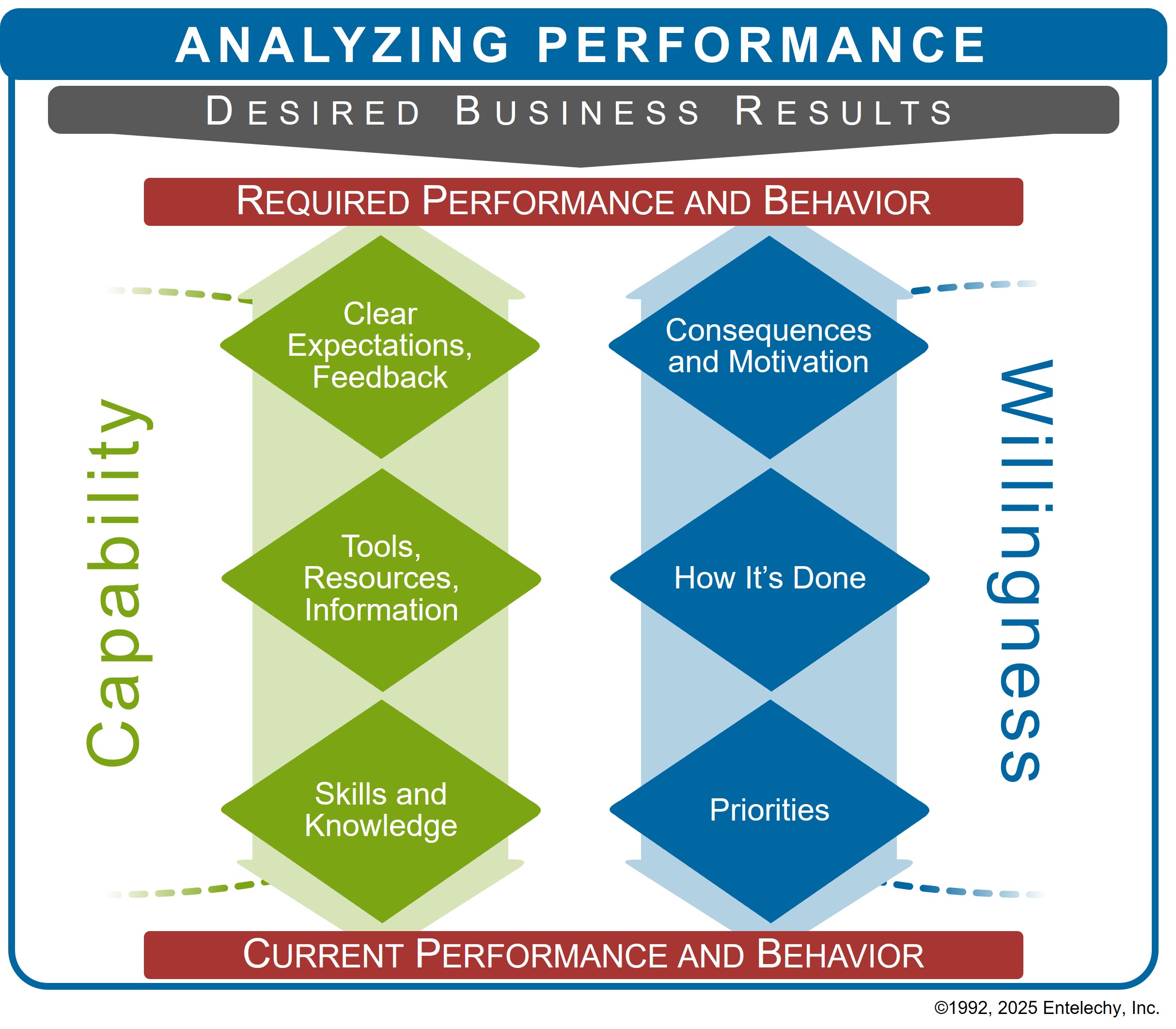
First, we'll take a look at Entelechy’s Analyzing Performance Model as a tool to illustrate the two primary things people need to perform: they need the capability and they need the willingness. We can further divide the reasons as follows:
Capability
- Employees need to clearly understand your expectations (what you want, when you want it, who you want included in the work, what level of autonomy you’re authorizing, how frequent you want status reports, etc.) AND they need to hear if they’re on the right track or not through ongoing constructive and positive feedback.
- They need the resources (time, people, information, budget) to do what you expect them to do.
- They need the skills or knowledge, and confidence in their abilities, to do what you expect.
Willingness
- Employees perform best when they are motivated and when the perceived positive outcomes for performing outweighs the effort or the perceived negative consequences.
- Sometimes there is a reason to do something a certain way yet employees may choose to do it their way, not your way. Employees need to understand, and buy into, the WHY.
- Employees need to understand the priority of a task or project.
The Analyzing Performance model is a wonderful tool for diagnosing and addressing performance issues; it’s also a valuable tool for enabling performance and for ensuring that the employee has the capability and willingness to succeed.
Begin at the Beginning
While many leaders use the heart of the Analyzing Performance model to diagnose and address performance issues, they know the model actually begins with Desired Business Results. Studies have shown that when employees know how what they’re doing fits into the larger picture (and that larger picture is meaningful to them), they perform better.
When you provide information about the organization, the organization’s goals, and your people’s role in the attainment of those goals, many wonderful things happen:
- Employees feel included and engaged
- Employees feel like they’re working on something meaningful, something big and good
- Employees feel that they are contributing in valuable ways
- Employees work more independently (and effectively)
- Individual and team decision making is improved
Much to our surprise, we are still sometimes asked how contemporary inclusionary leadership is more effective than old-style command-and-control management. Our answer can be summarized by the above list. Much of the work we do today requires some level of discretionary effort. Whether we want our employees to be more creative, be friendlier to customers, look for opportunities to cross-sell, improve safety, or any other skill that requires discretionary effort, people have to WANT to make the effort. And employees are more inclined to make, and sustain, that effort if they know how they fit and that their efforts contribute in meaningful ways.
Focus on the People by Focusing on the Organization
How do you enable discretionary performance … to engage employees more fully and contribute in more meaningful ways? One might immediately turn to relationships: managers connecting with employees on a personal and emotional level since we’ve all been taught that “employees don’t leave jobs, they leave bosses.” While the manager-employee relationship is important, it’s not the primary motivator, according to research done by Culture Amp, a company that provides insights into people and culture.
Culture Amp combed through the publicly available data and research on this topic, including their own core employee engagement surveys, to determine if people leave bad bosses. When looking at the employee’s intent to stay at their current company, Jason McPherson, Chief Scientist at Culture Amp, noticed that the relationship with one’s manager was less of a predictor than the employees’ belief in, and alignment with, the organization’s leadership (which includes purpose, development opportunities, etc.). The findings can be summarized as follows:
- Yes, people leave bad managers, but it is not the number one reason people leave a company.
- In “good” companies, managers make a difference.
- In “bad” companies, good or bad managers make little to no difference in a person’s decision to leave.
Not surprisingly, having a poor manager AND poor leadership results in the least commitment and engagement; and it’s no shocker that having both a great manager and great alignment with the organization’s leadership results in the most engagement. What IS surprising is that a majority of employees with bad bosses are likely to stay with their organization if they align with the organization’s leadership. That number is halved for employees with great bosses who will stay if they don’t feel an alignment with leadership.
Alignment matters!
How to Do It
Enable your employees’ performance by:
- Ensuring that they know what we do here. You may need to do a little research and reflection to help frame “what we do” and “why we do it” in ways that are meaningful to your employees.
- Exposing employees to the positive impact the company and its products and services have on the world and in their community.
- Aligning your team goals with the organization’s goals; show how our team contributes to the organization’s goals.
- Linking the goals of each team member to the team goals; show them that what they do matters.
- When assigning projects, delegating, coaching, and providing feedback, drawing the hard clean line between the activity and achievement of the goal.
- When managing performance, describing the impact of the behavior or performance on the achievement of team and organizational goals.
- Viewing your employees as partners who are critical to the success of the team.
- Trusting your people to do the work.
Josh Bersin, global HR expert, industry analyst, author, and educator, states, “I would suggest that using the word ‘engagement’ often limits our thinking. It assumes that our job is to reach out and ‘engage’ people, rather than to build an organization that is exciting, fulfilling, meaningful, and fun.”
If you want to enable performance, be the leader and provide the opportunities, support, and encouragement people need to succeed.